
Andaman & Nicobar Islands - a Sanctuary of Endemic Birds, a Magnet for Migratory Birds


Far out in the Bay of Bengal, closer to Myanmar and Southeast Asia than to mainland India, the Andaman & Nicobar Islands rise like emerald fragments from a deep blue sea. For birders and wildlife photographers, this remote archipelago is not just another destination—it is one of the most biologically intriguing corners of Asia. Very few places on the Indian subcontinent combine such high levels of endemism, rare migrants, and ecological variety in such a compact space.
At first glance, the islands enchant with their beaches, forests, and coral reefs. But look closer, and you’ll find a living laboratory of evolution.

Their extreme isolation from the Indian mainland has allowed many species to diverge over millions of years, evolving independently into the unique forms we see today.
Andaman Masked Owl, ©Abhijit Banerjee Andaman Drongo, ©Abhijit Banerjee Andaman Coucal, ©Abhijit Banerjee Andaman Cuckooshrike, ©Abhijit Banerjee Hume's Boobook, ©Abhijit Banerjee Andaman Treepie, ©Abhijit Banerjee Andaman Teal, ©Abhijit Banerjee Walden's Scops Owl , ©Abhijit Banerjee Andaman Wood Pigeon, ©Abhijit Banerjee Andaman Scops Owl, ©Abhijit Banerjee Andaman Woodpecker, ©Abhijit Banerjee Andaman Serpent Eagle Andaman Boobook Andaman Crake Andaman Starling / White-headed Starling Andaman Shama
The endemic birds of the Andaman & Nicobar Islands include:
Andaman Teal
Andaman Crake
Andaman Wood Pigeon
Andaman Cuckoo Dove
Andaman Green Pigeon
Andaman Serpent Eagle
Andaman Masked Owl
Andaman Scops Owl
Andaman Boobook
Hume’s Boobook
Andaman Nightjar
Andaman Coucal
Andaman Woodpecker
Andaman Treepie
Andaman Shama
Andaman Bulbul
Andaman Cuckooshrike
Andaman Flowerpecker
Andaman Drongo
White-headed Starling (Andaman Starling)
Pale-footed Bush Warbler - extremely tough to see bird, very secretive
Nicobar Megapode
Nicobar Imperial Pigeon
Nicobar Serpent Eagle
Nicobar Sparrowhawk
Nicobar Parakeet
Nicobar Scops Owl
Nicobar Hooded Pitta
Nicobar Jungle Flycatcher
Nicobar Bulbul
Great Nicobar Crake?? -
Following the easing of restrictions, recent birding trips to Great Nicobar Island have allowed for the photographing of a bird that might be a new species. While its presence is confirmed solely on this island, there is ongoing debate about its classification as a new species. The island is also home to two other crake species: the Slaty-legged Crake and the Red-legged Crake, suggesting that the "new species of crake" could potentially be a hybrid (YES! Hybrids do occur in nature!). Only genetic research can solve this mystery.

Great Nicobar Crake (undescribed form) ©Manjunath Desai/Macaulay Library Walden’s Scops Owl -
Once considered a subspecies of the Oriental Scops Owl, it is soon to be acknowledged as a distinct species!
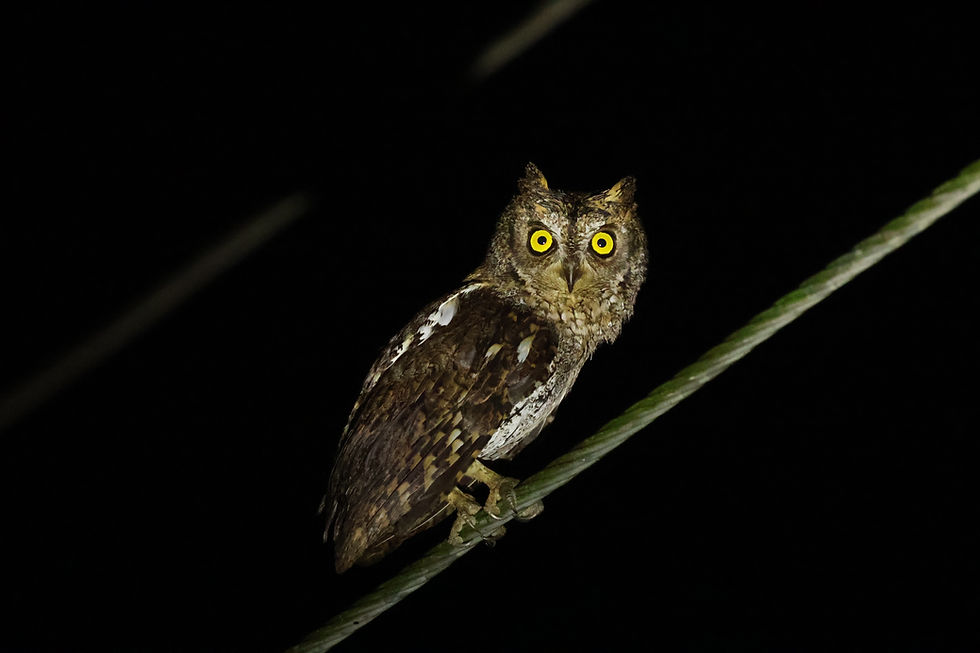
Walden's Scops Owl, South Andaman, February 2025
What makes the Andamans even more fascinating is their exceptional habitat diversity within a relatively small geographic area. The islands hold everything from ancient evergreen rainforests and dense mangrove swamps to peat forests, limestone caves, coastal scrub, and intertidal mudflats. These unique ecological pockets support a mosaic of bird communities, many adapted to extremely specialised niches. Mangrove specialists, canopy dwellers, dark-forest insectivores, and pelagic wanderers all coexist in an ecosystem unlike anything on mainland India.
And then, there are the annual migrants and vagrants: the unpredictable and storm-blown birds that make it to these islands. Situated between Southeast Asia and the Indian subcontinent, the Andamans lie at a natural crossroads for birds navigating two major flyways (migratory routes) - the East Asian- Australasian Flyway and the Central Asian-Indian Flyway. Many species, from songbirds to shorebirds, get blown off course by winter winds, monsoon storms, and tropical cyclones, funnelling them towards the islands.

There are quite a few migrants and resident birds of the Andamans that are very rarely/never found on mainland India:
Javan Pond Heron
Chinese Pond Heron
Chinese Egret
Japanese Sparrowhawk
Chinese Sparrowhawk
Ornate Sunbird
Daurian Starling
Red-necked Stint
Long-toed Stint
Pied Triller
Blyth’s Paradise Flycatcher
Pacific Swift
Pacific Swallow
Long-tailed Parakeet
Pacific Reef Heron
Oriental Reed Warbler
Black-browed Reed Warbler
Oriental Plover
Mangrove Whistler
Beach Thick-knee
Plume-toed Swiflet
Arctic Warbler
Chestnut-cheeked Starling
Freckle-breasted Woodpecker
White-breasted Woodswallow
Pacific Reef Heron Mangrove Whistler Olive-backed Sunbird White-winged Tern Pied Imperial Pigeon Oriental Reed Warbler Cinnamon Bittern Black-naped Tern Daurian Starlings White-bellied Munias Long-tailed Parakeet Chestnut-cheeked Starling Asian Glossy Starling Ruddy Kingfisher
This is why birders here encounter species that rarely or never reach mainland India, as well as pelagic species that wander closer to shore than expected. Every trip carries the electric possibility of a once-in-a-lifetime sighting.
Climate plays its own role in shaping this avian richness. The Andamans’ stable tropical warmth and frequent rainfall create lush, insect-rich environments year-round, making the islands a haven for tropical specialists and winter migrants alike. For many species fleeing harsh winters or resource-scarce months elsewhere, these forests offer refuge, rest, and food.
Despite their spectacular biodiversity, the Andaman & Nicobar Islands remain surprisingly underexplored. Dense terrain, restricted access to some regions, and logistical challenges mean many areas are still lightly surveyed. For birders, this adds a sense of adventure and discovery and fresh records continue to emerge each year. A few notable records from the islands in recent years were:
White-faced Plover - 1st record for India
Rufous-tailed Rock Thrush
Barau’s Petrel - 1st record for India
Chestnut-eared Bunting
Gray-streaked Flycatcher
Band-bellied Crake
The possibility of documenting a rare migrant or simply watching an endemic species in pristine habitat makes birding here deeply rewarding.
Ultimately, the Andaman & Nicobar Islands are a reminder of how isolation shapes life in extraordinary ways. They are also a reminder of how fragile such ecosystems can be. Their birds depend on the health of these forests and coastlines. Visiting the islands with sensitivity and curiosity not only provides unforgettable sightings but also contributes to the appreciation and conservation of a region that deserves global attention. Join us on our upcoming South Andaman Birding Tours to explore the islands in search of endemic, migrant and vagrant birds! Tour dates: 14th-19th January 2026 , 7th-12th February 2026


Comments